

Engineering Standards of High-Performance Open Top Shipping Containers
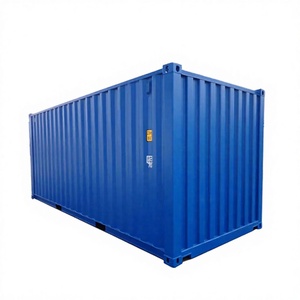
In modern multimodal project logistics, ordinary dry vans fail when faced with high-tonnage industrial assets, vertical overhead gantry crane loading, and high-cube machinery exceeding standard door heights. As an engineering-first China open top container manufacturer and turnkey supply partner, our facilities bridge the gap between heavy structural manufacturing and worldwide maritime compliance. Standard open top containers (OTCs)—available in 20GP, 40GP, and 40HQ form factors—feature fully removable roofs covered by heavy-duty tarpaulins (soft open top) or removable rigid Corten steel lids (hard open top). They are purpose-engineered to haul un-craneable capital assets such as marble slabs, precision CNC machinery, marine engines, pipeline spools, and electrical substation equipment.
Every unit produced within our Chinese manufacturing centers complies strictly with ISO 1496-1: Series 1 freight containers specifications, tested rigorously for stackability, end-wall resistance, side-wall deflection under maximum dynamic loads, and transverse racking. Because the removal of a rigid roof beam fundamentally changes the container’s torsional resistance, our open top containers integrate ultra-heavy-gauge cold-rolled Corten-A steel corner posts, high-yield top rails with continuous structural reinforcements, and articulated swing-out rear door headers (hinged lintels). This allows cranes to load heavy machinery directly over the floor without vertical door height limitations, saving hundreds of hours on job sites worldwide.
Corten-A Anti-Corrosive Metallurgy
Constructed from atmospheric corrosion-resistant structural steel with elevated copper-chromium alloying, guaranteeing minimal oxidization even when exposed to severe salt-mist ocean environments.
Removable Swing-Out Header
Features drop-down or swing-out rear lintels with secondary security locking pins, enabling horizontal roll-in or full vertical crane lowering without interference.
Certified CSC Safety Plate
Approved by premier classification societies (ABS, Lloyd’s Register, BV, or CCS), verified for stacked operational capacity of up to 192,000 kg on marine super-vessels.
Future Procurement Trends in the Global Open Top Container Market
Industrial procurement teams, freight forwarders, and EPC contractors are radically altering their sourcing behavior. Analysis of major engineering bids across North America, Europe, Southeast Asia, and the Middle East reveals three defining industry shifts:
1. The Shift to Hard Open Top (Hot Top) Dual-Function Units
While soft open top containers utilizing PVC tarpaulins with TIR cords remain the economical standard for non-sensitive freight, procurement of Hard Open Top (Hardtop) containers is accelerating by 14.8% annually. Hardtop units feature an engineered, detachable steel roof panel that locks securely into ISO corner castings. This provides the weather resistance and theft protection of a standard dry box container while retaining complete overhead accessibility for heavy gear. B2B purchasers minimize cargo insurance premiums while operating a dual-purpose asset that can carry out-of-gauge project equipment inbound, and moisture-sensitive FMCG or dry freight on return corridors.
2. Factory-Direct Modularization & Skid Pre-Integration
Industrial clients increasingly demand that China manufacturing hubs supply containers not as empty shells, but as integrated mechanical housings. For example, in utility infrastructure and clean tech, equipment manufacturers configure 20ft & 40ft open tops as drop-in transformer and switchgear enclosures. Power distribution lines, cooling ducts, and bottom skids are welded directly into the floor bolster channels before the container leaves the factory floor. This prefabricated approach compresses field commissioning schedules on mega-projects by months.
3. Circular Carbon Auditing and Eco-Certified Coatings
Global supply chain compliance, particularly across UK and EU ports (under CBAM and corporate ESG mandates), requires verified Scope 1, 2, and 3 footprint tracking. Advanced Chinese container factories are transitioning to fully automated robotic waterborne paint lines—eliminating 90% of volatile organic compound (VOC) emissions compared to legacy solvent coatings. Sustainable procurement contracts now explicitly require factory environmental audits, eco-tarpaulins made of recyclable polymers, and audited lifetime lifecycle metrics.
Technological & Design Evolution of Open Top Containers
The open top container segment has advanced far beyond simple box fabrication. Structural finite element analysis (FEA) ensures that our frames distribute heavy point loads across the chassis without floor sag. Standard OTC floors are constructed with 28mm certified marine plywood or optional 4.5mm checkered steel plate floor decking, reinforced with transverse cross-members spaced at tight intervals to support extreme forklift axle pressures exceeding 7,260 kg (ISO 1496 standard).
TIR High-Performance Tarpaulins
- 650g/m² to 900g/m² UV-stabilized PVC tarpaulin
- Integrated steel wire TIR cord with terminal ends
- Customs-sealable for cross-border transit
High-Capacity Lashing Ring Systems
- Heavy-forged D-rings on side floor rails (2,000–4,000kg rated)
- Corner post lash brackets for cross-chaining
- Fully compliant with IMO / ILO / UNECE cargo code
Modular Roof Bow Architecture
- Arched galvanized roof bows to prevent water ponding
- Precision bayonet locks with safety chains
- Quick-release mechanisms for rapid unshipping
Procurement FAQ: Critical Factors in Open Top Container Sourcing
What is the structural difference between Hard Open Top and Soft Open Top containers?
How does an Open Top Container maintain transverse rigidity without a fixed steel roof?
Can you provide CSC certification and maritime approval for out-of-gauge shipping?
What custom internal coatings and floorings are available for abrasive or heavy cargo?
What are the lead times and batch production capacities for overseas OEM orders?
Enterprise Advantage: Seamless Integration with Global 3PL Infrastructure
Sourcing specialized containers from China is only half the battle; the true competitive advantage lies in integrating manufacturing with international multimodal shipping, customs compliance, and port handling. Drawing on over 30 years of integrated logistics experience, our operational infrastructure spans both Chinese production centers and major global container gateways—including London Heathrow, Felixstowe, Liverpool, and the Port of Ipswich.
Unlike pure steel mills that abandon clients at the factory gate, our clients benefit from single-contract project management. We manufacture your custom open top containers, coordinate factory loading, clear export declarations, book FCL or breakbulk vessel space, and provide door-to-door delivery with bonded storage options. With audited ISO 9001:2015 quality management and BRCGS AA+ certified storage operations, every consignment is protected by documented quality control and complete supply chain transparency.
Whether you are an EPC contractor deploying gas turbines into the Middle East, a mining operator procuring half-height open top bulk carriers for Australia, or an international plant manager shipping over-height machinery into continental Europe, our integrated manufacturing and forwarding network guarantees zero demurrage, minimized landed costs, and full regulatory compliance.
Connect with our Engineering & Logistics Consultants
Get instant factory quotations, custom CAD drafting assistance, and competitive door-to-door ocean freight rates for 20ft, 40ft, and non-standard Open Top Containers.
Contact Us